
Last week was a week of dramatic developments across markets. The plunge in Tech and especially AI stocks did not come as a surprise to us, as, knowing that this was a bubble in search of a pin, we had been expecting it to pop for some time, and when it started to last week, it dragged down the broad market with it. The catalyst for this development was the big gains made by the Democratic Party in the election and the resulting fears that the party will put the brakes on the data center buildup. What was surprising last week, though, was the resilience of the Precious Metals sector, which not only held its ground but actually rose, which is a sign that some of the money fleeing the Tech sector is rotating into the downtrodden PM sector as a safe haven. The significance of this becomes even more clear when you look at the performance of the PM sector relative to the broad market and especially the Tech sector. Before looking at the relative chart, we will briefly review the VanEck Gold Miners chart (GDX).
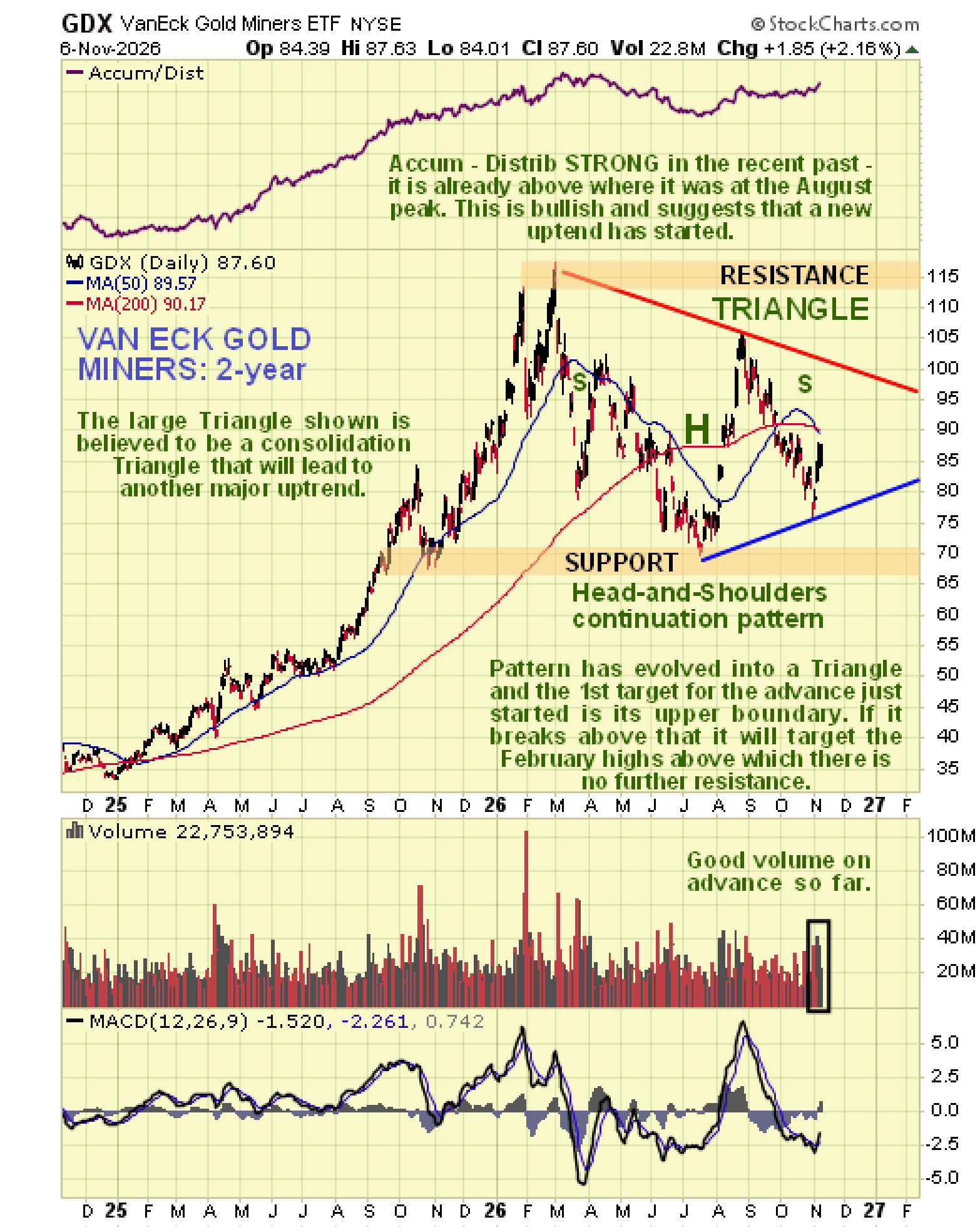
On the 2-year chart for GDX, we can see that the Head-and-Shoulders continuation pattern that we had earlier identified, which is now approaching completion, lies within a large Symmetrical Triangle, which is also approaching completion. Just last week it started to rally off the lower boundary of this Triangle on good volume, and a very important point to note is that, on the substantial correction back from the late August peak, not only did the Accumulation line not drop back but it actually made gains. This is viewed as a very bullish divergence, and just on the basis of that, it is reasonable to expect a sizable uptrend to develop from here; in addition, we have just entered the most bullish time of year for the sector.

The sector gains last week were somewhat muted and masked by the heavy drop in the Tech sector and also in the broad market but we can throw a strong light on the extent and significance of the outperformance of the PM sector by the simple expedient of plotting GDX against the Nasdaq Composite index and we will use a 3-month chart as we want to focus on recent action.
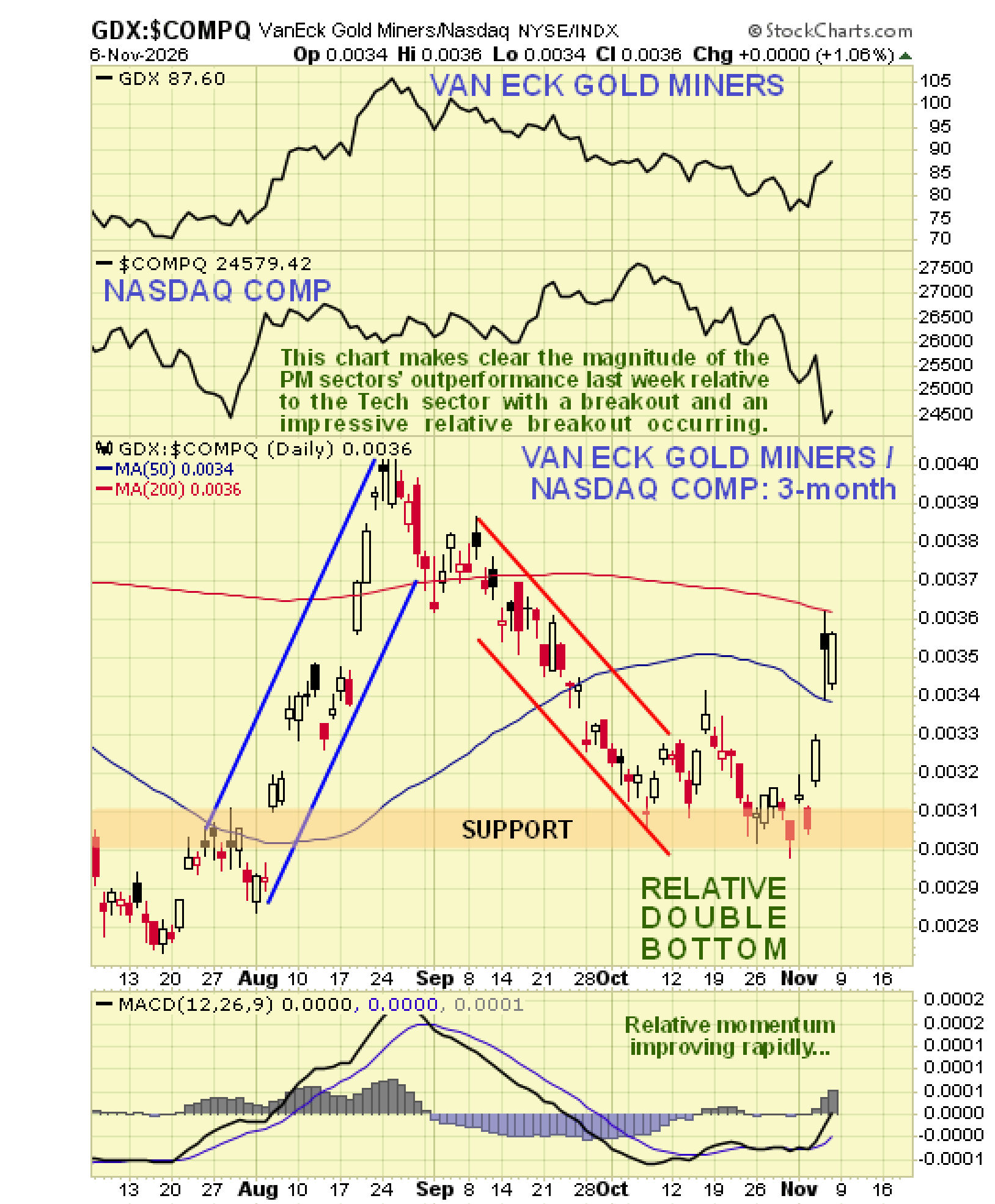 So, looking at the chart for GDX over the Nasdaq Comp, we can see that there was quite a dramatic breakout last week from a relative Double Bottom that formed during October. Given that GDX actually rose last week while the Tech sector and the market as a whole tanked, it looks very much like some of the “funk money” fleeing the Tech sector sluiced into the PM sector as a safe haven.
The rally in the PM sector as the broad market and Tech sector plunged raises the question of whether this will continue to happen in the event of an all-out market crash, but we now have an environment where an all-out market crash may not happen at all – here’s why: the stock market is now largely owned by Big Money with BlackRock, State St, and Vanguard alone owning 70% of it. What this means is that if they can get society at large to foot the bill to keep it propped up they will. The Fed doesn’t answer to the American people; it exists to serve the interests of Big Money and furthermore, it can create as many trillions of dollars out of thin air as it likes with no accountability or oversight. This means that it can inject infinite quantities of money into the market to keep it elevated or stop it dropping, or to buy Treasuries to keep a lid on interest rates and stick the general population with the bill for it all via rampant inflation and a weakening currency. The reason that the dollar is still strong relative to other currencies is that these kind of policies are being applied all around the world, and so, even though the dollar may look like “the cleanest shirt in the laundry basket” it continues to lose purchasing power at a rapid rate.
So, rather than an all-out massive market crash, what we might see instead is occasional “crashlets” such as we witnessed last week, due to abrupt changes of sentiment that throw up trading buying opportunities, and of course, the ongoing robust inflation, despite deflationary forces also being in play, has to be positive for investments with real intrinsic value such as gold and silver. Another positive factor for markets is that oil has broken down quite decisively and looks set to continue to drop, as the drubbing the Republicans suffered last week has curbed their enthusiasm for another assault on Iran, with the election result in Israel thought likely to have a similar effect. If oil prices continue to ease it could have a stabilizing effect on markets that are in any case, buoyed up by endless Central Bank money pumping, thus creating a favorable environment in which the Precious Metals sector can advance.
We will now proceed to look at a range of Precious Metals stocks in separate articles that look set to make good gains, starting with silver stocks, as they haven’t moved (or haven’t moved much) yet.
End of article.
About the author