
Vancouver, British Columbia--(Newsfile Corp. - February 27, 2026) - BP Silver Corp. (TSXV: BPAG) ("BP Silver" or the "Company") announces final assay results ("Assays") from the remaining eight drill holes of its eleven-hole Phase I drill program (the "Program") at the Cosuño Silver Project ("Cosuño") in Bolivia.
Highlights
- Drilling intersected multiple zones of high-grade silver mineralization at the Pocañita Chica target: Diamond Drill Hole ("DDH") CO-0008 returned 5m @ 600.4 g/t silver, including 1m @ 1655 g/t silver; CO-0009 returned 1m @ 526 g/t silver and 6m @ 147 g/t silver.
- The Program achieved its primary objective of confirming silver mineralization within the lithocap beneath surface geochemical anomalies, materially de-risking Cosuño.
- Silver mineralization was intersected in all four targets tested across an approximately 2.7 km NE-SW corridor, confirming the presence of a robust silver and polymetallic system which remains open for expansion along strike and at depth.
Dr. Stewart D. Redwood, Director and Qualifying Person, stated,
"Our recent drill program has delivered compelling high-grade silver results, highlighted by an intersection of 5 meters at 600.40 g/t silver and 1 meter grading 1,655.00 g/t silver — equivalent to an exceptional 1.65 kilograms of silver per tonne over that interval. These results validate the potential discovery of deposit within the large 10.5 km² alteration zone that remains largely covered and only minimally tested, underscoring the significant exploration upside. The next phase of exploration will advance the project through extensive geophysical surveys to better define the size and continuity of the four drilled targets, refine Phase II drill planning, and identify additional targets concealed beneath thin surface cover, positioning the project for continued growth."
Dr. Redwood continued, "We expect Cosuño's grades to increase when we drill deeper into and below the lithocap. Lithocaps are extensive zones of clay and silica alteration that form in the top part of Bolivian polymetallic vein systems and tin porphyries, similar to those which overlie porphyry copper deposits. The nearest neighbour to Cosuño, in a similar geological setting, the Pulacayo deposit, has a large lithocap that is barren and conceals a major vein that produced 640 million ounces of silver and 200,000 tons each of lead and zinc."
Readers are cautioned that the Pulacayo deposit discussed above is an adjacent property and that BP Silver has no interest in or right to acquire any interest in the deposit, and that mineral deposits on adjacent or similar properties, and any production therefore or economics with respect thereto, are not in any way indicative of mineral deposits on BP Silver's Cosuño property or the potential production from, or cost or economics of, any future mining of any of BP Silver's mineral properties.
Drill Results
Assays released are from the remaining 8 drill holes (results from CO-0001 and CO-0002 were previously released in a news release dated February 2, 2026), which tested four initial surface targets identified within the large ~10.5km2 Cosuño hydrothermal system (Table 1 & Figure 1).
The assays demonstrate that silver and gold mineralization identified at surface continues at depth within the lithocap. The results are significant because lithocaps are usually barren in similar Bolivian systems, indicating Cosuño's potential for further discoveries at depth and in covered areas.
|
Hole No |
Target |
From m |
To m |
Interval m |
Ag g/t |
Au g/t |
AgEq g/t |
|
CO-0001 |
Jalsuri |
22 |
86 |
64 |
37.29 |
0.21 |
51.96 |
|
inc. |
35 |
64 |
29 |
56.03 |
0.28 |
75.15 |
|
|
inc. |
35 |
40 |
5 |
97.72 |
0.39 |
122.97 |
|
|
And |
48 |
51 |
3 |
129.93 |
0.47 |
159.51 |
|
|
CO-0002 |
Jalsuri |
42 |
77 |
35 |
22.8 |
0.44 |
57.41 |
|
inc. |
57 |
59 |
2 |
43.75 |
1.34 |
150.96 |
|
|
CO-0003 |
Jalsuri |
7 |
35 |
28 |
30.58 |
0.27 |
50.66 |
|
inc. |
14 |
20 |
6 |
47.70 |
0.58 |
92.09 |
|
|
inc. |
30 |
33 |
3 |
57.30 |
0.37 |
83.74 |
|
|
inc. |
32 |
33 |
1 |
105.00 |
0.59 |
146.20 |
|
|
CO-0003A |
Jalsuri |
14 |
57 |
43 |
20.40 |
0.15 |
31.32 |
|
inc. |
14 |
27 |
13 |
34.28 |
0.16 |
45.05 |
|
|
inc. |
33 |
46 |
13 |
25.17 |
0.18 |
38.22 |
|
|
CO-0004 |
Pocalleta |
10.6 |
35.6 |
25 |
61.13 |
0.02 |
58.50 |
|
inc. |
19.6 |
21.6 |
2 |
212.50 |
0.04 |
200.92 |
|
|
inc. |
26.6 |
30.6 |
4 |
142.18 |
0.04 |
135.52 |
|
|
42.6 |
47.6 |
5 |
56.64 |
0.02 |
54.32 |
||
|
inc. |
45.6 |
46.6 |
1 |
243.00 |
0.07 |
231.75 |
|
|
CO-0006 |
Benhur |
28 |
31 |
3 |
54.43 |
0.07 |
56.38 |
|
inc. |
30 |
31 |
1 |
123.00 |
0.09 |
121.80 |
|
|
CO-0006A |
Benhur |
24 |
27 |
3 |
80.63 |
0.07 |
80.75 |
|
43 |
46.2 |
3.2 |
63.29 |
0.03 |
61.33 |
||
|
CO-0007 |
Benhur |
28.35 |
32.35 |
4 |
67.65 |
0.09 |
70.32 |
|
CO-0008 |
Pocanita Chica |
11 |
49 |
38 |
116.39 |
0.01 |
109.07 |
|
inc. |
29 |
34 |
5 |
600.40 |
0.01 |
559.19 |
|
|
inc. |
30 |
31 |
1 |
1655.00 |
0.01 |
1539.97 |
|
|
CO-0009 |
Pocanita Chica |
19 |
77 |
58 |
46.23 |
0.02 |
44.64 |
|
inc. |
19 |
22 |
3 |
240.03 |
0.01 |
224.05 |
|
|
And |
19 |
20 |
1 |
526.00 |
0.01 |
490.00 |
|
|
inc. |
33 |
39 |
6 |
147.10 |
0.01 |
137.63 |
Table 1: Significant drill intersections from Phase I drilling, Cosuño Silver Project.
Notes to the table:
- Intersections calculated at cutoff grades of 10 g/t Ag with sub-intervals at 30, 60 and 90 g/t Ag, or 0.5 and 1.0 g/t Au. The intervals may include some internal dilution.
- Au for CO-0001 and CO-0002 is by fire assay 30 g with AAS finish (AA-25).
- Au for CO-0003 to CO-0009 is by ICP (ME-MS41) which is semi-quantitative and is preliminary until fire assay (AA25) is completed.
- Ag and multielement were analyzed by aqua regia and ICP-MS (ME-MS41). Ag >100 ppm was reassayed by aqua regia and ICP-AES (Ag-OG46). Ag > 1000 g/t was reassayed by fire assay and gravimetry (Ag-GRA46).
- AgEq = (Ag grade * Ag recovery) + ((Au grade * Au price/ Ag price) * Au recovery).
- Prices Au $3431.54/oz, Ag $40.03/oz (London Bullion Market Association average 2025).
- The project is at an early stage, and there is no metallurgical test work to date. Assumed recoveries are 93% Ag and 96% Au by comparison with the Santa Ana deposit, Colombia (NI 43-101 mineral resource report for Outcrop Silver and Gold Corporation, 8 June 2023).
- For CO-0001 and CO-0002, AgEq is restated from the previous press release using the assumed recovery factors.
- Above are core lengths as true widths are not known at this time.
- Hole CO-0005 was not drilled. CO-0010 intersected no significant mineralization and therefore was not submitted for assay.
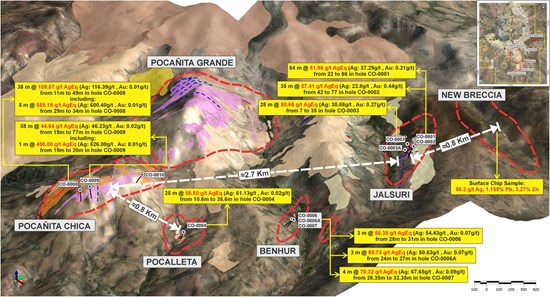

Figure 1: Cosuño mineralized corridor, demonstrating a multi-kilometer hydrothermal corridor with confirmed silver-dominant mineralization at several targets.
To view an enhanced version of this graphic, please visit:
https://images.newsfilecorp.com/files/11890/285601_597d5935c4a4a857_002full.jpg
The Program successfully tested key zones along a 2.7 km structural trend, returning significant silver intercepts at the 4 targets tested to date (Figures 1 to 3):
- Pocañita Chica – Broad mineralized envelopes with high-grade silver intervals hosted in hydrothermal breccias.
- Pocalleta – Structurally controlled vein mineralization confirming depth potential.
- Jalsuri – High-grade silver intercepts with gold 2.7 km northeast of Pocañita Chica, indicating district-scale continuity.
- Benhur – Additional silver mineralization along the same structural corridor.
Cosuño Drill Program Overview
The Program tested four priority targets defined by structurally controlled, outcropping geochemically anomalous to highly anomalous silver-rich polymetallic zones characterized by silicification, intermediate to advanced argillic alteration, sulfides and brecciation: features typical of many significant Bolivian silver deposits. The targets occur within a large ~10.5 km² hydrothermal alteration system as defined by detailed mapping, geochemical sampling and remote sensing alteration studies (Figure 1).
Figures and additional geological background from the initial program can be found in the Company's news releases of October 21, 2025, November 14, 2025, and February 2, 2026.
Detail
This marks the first drill program completed within the Cosuño project. Holes CO-0001 and CO-0002 (Figure 1 and Table 2) were previously reported in a news release dated February 2, 2026.
|
Hole_ID |
Easting |
Northing |
Depth (m) |
Azimuth (°) |
Dip (°) |
|
CO-0001 |
747065 |
7762846 |
101 |
235 |
-45 |
|
CO-0002 |
747063 |
7762848 |
107 |
170 |
-45 |
|
CO-0003 |
746997 |
7762848 |
56 |
80 |
-50 |
|
CO-0003A |
747037 |
7762775 |
74 |
30 |
-55 |
|
CO-0004 |
746463 |
7760731 |
66 |
195 |
-65 |
|
CO-0006 |
746972 |
7761491 |
48 |
230 |
-60 |
|
CO-0006A |
746971 |
7761490 |
90 |
230 |
-45 |
|
CO-0007 |
746975 |
7761491 |
80 |
200 |
-45 |
|
CO-0008 |
745656 |
7760370 |
100 |
130 |
-50 |
|
CO-0009 |
745692 |
7760449 |
100 |
125 |
-55 |
|
CO-0010 |
745855 |
7760900 |
84 |
200 |
-50 |
Table 2: Phase I drill program collars.
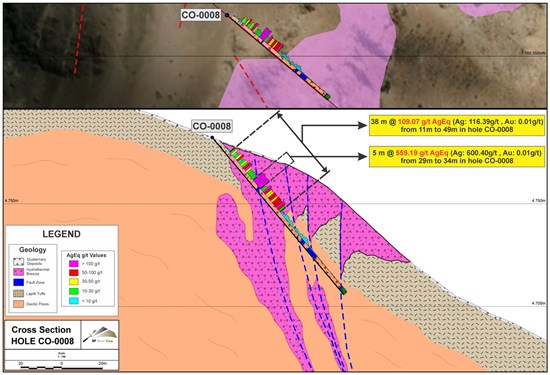
Figure 2: Geological cross-section of the Pocañita Chica Target displaying interpreted structural controls on mineralization along the drill hole trajectory and the corresponding mineralized intercept in DDH CO-0008.
To view an enhanced version of this graphic, please visit:
https://images.newsfilecorp.com/files/11890/285601_597d5935c4a4a857_005full.jpg
Mineral System Analysis
Interpretation of the results from the Pocañita Chica and Pocalleta targets highlight approximately 300 meters of vertical difference and a lateral separation of about 0.8 km between the two targets (Figure 3). Importantly, geochemical results indicate elevated copper, tin and indium values at lower elevations within the system (Table 3). This vertical metal zonation suggests strengthening base and critical-metal enrichment at depth, consistent with a vertically developed polymetallic system.
The geological cross section below shows the vertical and lateral relationship between the Pocañita Chica resurgent dome and the deeper Pocalleta vein system within the Cosuño caldera (Figure 1 & 3). Both targets are interpreted as parts of a single, large, vertically zoned magmatic-hydrothermal system. Pocañita represents a shallow resurgent dome affected by intense hydrothermal brecciation and strong silver mineralization (Figure 4A). Advanced argillic alteration (quartz-alunite ± pyrophyllite) is commonly associated with a high-sulfidation epithermal mineralization environment formed at shallow depth reflecting vigorous metal bearing fluid upflow.
Approximately 0.8 km away and structurally deeper, the Pocalleta vein system is hosted in competent volcanic rocks. Alteration is dominated by white mica, indicating higher temperatures and deeper formation levels. Mineralization includes significant silver with anomalous tin and freibergite, supporting a hotter, more proximal position relative to the intrusive source (Figure 4B). The silver-tin association, white mica alteration, and temperature-sensitive alteration suggest that Pocalleta represents a deeper, more thermally evolved part of the same system. This vertical metal and alteration zoning is similar to that found in productive Bolivian silver systems.
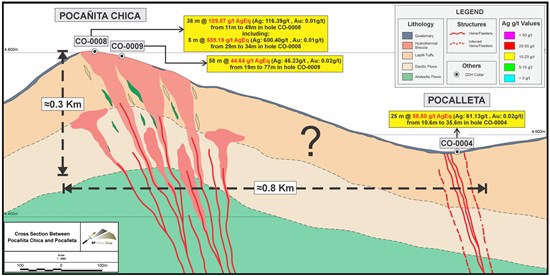
Figure 3: Geological Interpretation – Pocañita–Pocalleta System, Cosuño Project.
To view an enhanced version of this graphic, please visit:
https://images.newsfilecorp.com/files/11890/285601_597d5935c4a4a857_006full.jpg
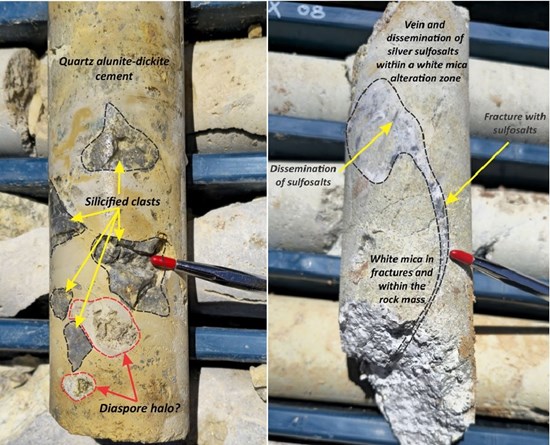
Figure 4A: Hole CO-0008 from 30m to 31m, 1m @ 1655 g/t silver in matrix supported polymictic hydrothermal breccia with strong silicification and advanced argillic alteration / cement (alunite, dickite, diaspore) and silver sulfosalts. Figure 4B: Hole CO-0004 from 29.6m to 30.6m, 1m @ 261 g/t silver in veinlet with white mica alteration and veinlet with silver sulfosalts.
To view an enhanced version of this graphic, please visit:
https://images.newsfilecorp.com/files/11890/285601_figure%204a%20and%20figure%204b.jpg
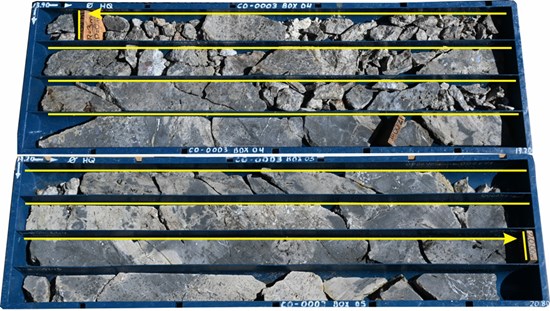
Figure 5: Hole CO-0003 from 14m to 20m: 6m @ 92.09 g/t AgEq (47.7 g/t silver, 0.58 g/t gold). Hydrothermal and crackle breccia with strong advanced argillic alteration (quartz, alunite, dickite with pyrite, sulfosalts, sulfides drusy quartz.
To view an enhanced version of this graphic, please visit:
https://images.newsfilecorp.com/files/11890/285601_597d5935c4a4a857_011full.jpg
Polymetallic System Potential
Silver is hosted within a polymetallic mineral system and is associated with antimony, bismuth, copper, indium, lead, tin, and zinc. These metals occur both within the main mineralized zones and along their margins, forming a complex zonation pattern. While currently present at generally low grades, some, subject to ongoing positive exploration and associated metallurgical studies, may be recoverable as by-products. Metal concentrations may also increase with depth. The best polymetallic drill intersections are listed in the following table (Table 3).
|
Metal |
Intersection |
Hole |
From (m) |
|
Antimony |
38.0 m at 0.18% Sb |
CO-0008 |
11.0 |
|
5.0 m at 0.17% Sb |
CO-0009 |
33.0 |
|
|
Bismuth |
38.0 m at 0.47% Bi |
CO-0008 |
11.0 |
|
inc. 5.0 m at 0.58% Bi |
CO-0008 |
29.0 |
|
|
inc. 1.0 m at 2.2% Bi |
CO-0008 |
30.0 |
|
|
49.0 m at 0.07% Bi |
CO-0009 |
19.0 |
|
|
inc. 3.0 m at 0.22% Bi |
CO-0009 |
60.0 |
|
|
Copper |
11.0 m at 0.10% Cu |
CO-0004 |
19.6 |
|
Indium |
15.0 m at 11.35 ppm In |
CO-0004 |
6.6 |
|
Lead |
13.0 m at 0.89% Pb |
CO-0008 |
11.0 |
|
inc. 1.0 m at 1.94% Pb |
CO-0008 |
19.0 |
|
|
10.0 m at 0.43% Pb |
CO-0009 |
19.0 |
|
|
Tin |
12.0 m at 0.13% Sn |
CO-0008 |
38.0 |
|
inc. 1.0 m at 1.45% Sn |
CO-0008 |
46.0 |
|
|
5.0 m at 0.018% Sn |
CO-0009 |
19.0 |
|
|
Zinc |
12.0 m at 0.51% Zn |
CO-0001 |
89.0 |
Table 3: Key pathfinder elements intersected during Phase I drilling.
Engagement of Adelaide Capital
Further to the Company's news release dated February 2, 2026, the Company confirms that it has engaged Adelaide Capital ("Adelaide"), a leading investor relations and capital markets advisory firm, to provide investor relations and consulting services to the Company.
Adelaide is a full-service investor relations firm that brings a unique and powerful perspective and a re-engineered investor relations business model. Adelaide will work closely with BP Silver to develop and deploy a comprehensive capital markets program, which includes assisting with non deal road shows, virtual campaigns, social media, conferences and assisting with investor communication. In exchange for Adelaide's services, and pursuant to an investor relations consulting agreement (the "IRA"), the Company has agreed to pay a monthly fee of C$10,000. The term of the agreement is from February 1, 2026 to April 1, 2026 and will automatically renew on a month-to-month basis for the same monthly fee. Either party may terminate the agreement by providing 30 days' written notice to the other party.
Adelaide is an arm's length company based in Toronto, Ontario. As of the date hereof, Adelaide does not have any interest, directly or indirectly, in the Company or its securities except for being previously granted 50,000 options of the Company at a price of $0.15 per share until September 25, 2030. The options were granted in connection with the Company's Qualifying Transaction for corporate administrative services, such as, website and corporate presentation development and did not relate to any investor relations services. The IRA is subject to approval by the TSX Venture Exchange.
Qualified Person
The technical information contained in this news release has been reviewed and approved by Dr. Stewart D. Redwood, PhD, FIMMM, a Director of the Company and a Qualified Person as defined under National Instrument 43-101 – Standards of Disclosure for Mineral Projects. As Dr. Redwood is a director of the Company, he is not independent under National Instrument 43-101.
Mineralization at the Pulacayo mine is not necessarily indicative of mineralization at the Cosuño Project. Information on historical production from the Pulacayo mine was obtained from SERGEOMIN, Bulletin of the National Service of Geology and Mining, No. 30, 2002, pp. 119-120.
QA/QC
The work program was designed and supervised by Gonzalo Lemuz, P.Geo, the Company's Chief Operating Officer, who was responsible for all aspects of the work, including the Quality Assurance and Quality Control (QA/QC) program. On-site personnel at the Project rigorously collect and track samples which are then security sealed and shipped to ALS laboratory in Oruro for sample preparation. The core samples were prepared by ALS at their laboratory in Oruro, Bolivia and the sample pulps were shipped to their laboratory in El Callao, Peru for analysis. ALS is accredited to ISO/IEC 17025:2017 and ISO9001:2015. ALS is independent of BP Silver. Silver and multi-elements were analyzed by aqua regia digestion and ICP-MS finish (ME-MS41). Gold for CO-0001 and CO-0002 was analyzed by fire assay and AA finish (AA25). Gold for CO-0003 to CO-0009 is by ICP (ME-MS41) which is semi-quantitative and is preliminary until fire assay (AA25) is completed. Overlimit Ag >100 ppm was reassayed by aqua regia and ICP-AES (Ag-OG46). Ag > 1000 g/t was reassayed by fire assay and gravimetry (Ag-GRA46).
BP Silver inserted certified standard reference materials (CSRM), blanks and duplicates to monitor QA/QC. All diamond drill holes were drilled in HQ diameter. The average core recovery was 96.4%.
About BP Silver Corp.
BP Silver Corp. is a Canadian exploration company focused on advancing high-grade silver projects in Bolivia. The Company's flagship asset, the Cosuño Project, is strategically located in the prolific Bolivian silver belt, a region with a rich mining history and significant untapped discovery potential. With a strong technical team and a disciplined exploration strategy, BP Silver is positioned to unlock value for its shareholders through the discovery and development of major silver deposits.
For further information, please contact:
Tim Shearcroft, Founder and Chief Executive Officer
604-307-7032
Info@BPSilverCorp.com
Cautionary Statement Regarding Forward-Looking Information:
Information set forth in this news release contains forward-looking statements. These statements reflect management's current estimates, beliefs, intentions and expectations; they are not guarantees of future performance. The Company cautions that all forward-looking statements are inherently uncertain and that actual performance may be affected by a number of material factors, many of which are beyond the Company's control. Such factors include, among other things: future prices and the supply of silver and other precious and other metals; future demand for silver and other valuable metals; inability to raise the money necessary to incur the expenditures required to retain and advance the property; environmental liabilities (known and unknown); general business, economic, competitive, political and social uncertainties; results of exploration programs; risks of the mineral exploration industry; delays in obtaining governmental approvals; and failure to obtain necessary regulatory or shareholder approvals. There can be no assurance that such statements will prove to be accurate, as actual results and future events could differ materially from those anticipated in such statements. Accordingly, readers should not place undue reliance on forward-looking statements. The Company disclaims any intention or obligation to update or revise any forward-looking statements, whether as a result of new information, future events or otherwise, except as required by law.
NEITHER THE TSX VENTURE EXCHANGE NOR ITS REGULATION SERVICES PROVIDER (AS THAT TERM IS DEFINED IN POLICIES OF THE TSX VENTURE EXCHANGE) ACCEPTS RESPONSIBILITY FOR THE ADEQUACY OR ACCURACY OF THIS RELEASE
About the author

 BP Silver is a newly listed Canadian silver exploration company, trading on the TSX Venture Exchange under the ticker "BPAG". The company’s flagship Cosuño Project in Potosí, Bolivia, lies within the prolific Bolivian silver belt near world-class deposits like Cerro Rico and San Cristobal.
Surface sampling at Cosuño returned silver grades of up to 1,035 g/t Ag, with significant base-metal by-products. Following its TSX-V listing in September 2025, BP Silver initiated and completed the first-ever diamond drilling program at the project between November and December 2025. The Phase 1 program comprised eleven diamond drill holes totaling 906 metres, testing four high-priority targets across an approximately 10.5 km² hydrothermal alteration system. The system is characterized by geochemical anomalies, strong alteration, and brecciation—typical features of major Bolivian silver systems. Initial assay results are expected in January 2026.
Led by a proven team with decades of Latin American and global mining success, BP offers investors early exposure to a tightly held silver discovery play in one of the world's richest yet underexplored regions.